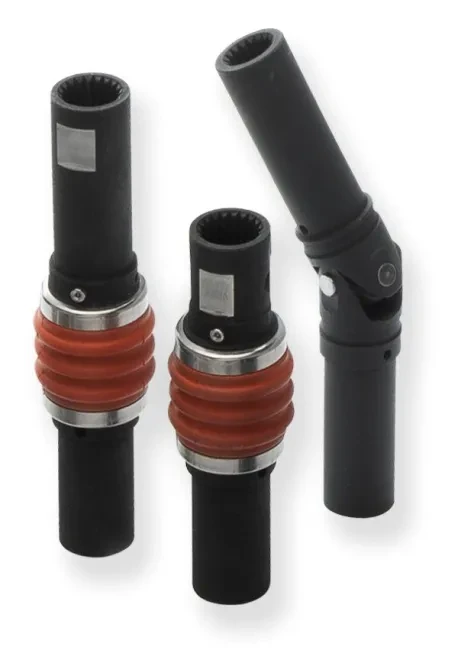
What Is a Universal Joint?
A universal joint (U-joint) is a mechanical coupling that connects two rotating shafts whose axes are not aligned. Universal joints transmit rotational motion and torque between shafts that meet at an angle, typically ranging from 0 to 45 degrees depending on the specific design and application requirements. A Single Universal Joint can compensate angular misalignment. Double Universal Joints can compensate parallel misalignment as well. Telescopic Drive Shafts can also compensate axial misalignment.
In aerospace and defense systems, universal joints enable power transmission in confined spaces where direct shaft alignment is impossible. These components are critical in aircraft control systems, helicopter rotor mechanisms, UAV gimbal assemblies, and satellite positioning systems.
How Does a Universal Joint Work?
Universal joints operate on a simple mechanical principle: they use a cross-shaped component called a spider or cruciform that connects two shaft yokes through perpendicular pivot points. This design allows one shaft to rotate another shaft even when their axes intersect at an angle.
The basic operation involves four main steps:
1. Input shaft rotation drives the first yoke
2. First yoke transfers motion to the spider through needle Bearings
3. Spider transmits rotation to the second yoke at 90-degree offset
4. Second yoke drives the output shaft at the desired angle
Key Components of Universal Joints
Spider (Cruciform)
The spider is the central cross-shaped component with four cylindrical journals extending at 90-degree intervals. Each journal typically measures 10-25mm in diameter for aerospace applications. The spider material is usually high-strength steel (AISI 4140 or similar) with surface hardening to HRC 58-62.
Yokes
Yokes are U-shaped components that connect to input and output shafts. Aerospace yokes are machined from high grade alloy steel, sometimes corrosion resistant alloys or aluminum alloy, depending on weight requirements. Each yoke contains precision-bored holes that accept the spider journals with needle bearing assemblies or friction bearings.
Needle Bearings
Needle bearings reduce friction between the spider journals and yoke bores. These bearings consist of hardened steel needles (typically 1-3mm diameter) contained within precision-ground races. Aerospace-grade needle bearings operate reliably from -65°F to +350°F.
Seals and Lubrication
High-performance seals prevent contamination while retaining specialized lubricants. Aerospace universal joints use synthetic greases or dry film lubricants rated for extreme temperatures and vacuum conditions.
Universal Joint Operating Characteristics
Angular Velocity Variation
Universal joints do not maintain constant angular velocity when operating at angles greater than zero degrees. The output shaft alternately leads and lags the input shaft twice per revolution. This velocity variation increases with joint angle - at 10 degrees, variation is approximately 1.5%, while at 30 degrees it reaches 15.5%.
Torque Transmission
Torque capacity depends on spider journal diameter, bearing load ratings, and material strength. Typical aerospace universal joints handle torques from 10 lb-in for small UAV applications up to 10,000 lb-in for helicopter main rotor systems.
Maximum Operating Angles
Standard Single universal joints operate effectively up to 35-45 degrees maximum angle. Beyond these limits, bearing loads become excessive and component life decreases rapidly. Applications requiring larger angles use constant velocity joints or multiple U-joint Arrangements like double universal joints or telescopic drive shafts.
Types of Universal Joints in Aerospace
Single Universal Joints
Single U-joints are the simplest configuration, suitable for applications where angular velocity variation is acceptable. Common in control linkages, antenna positioning systems, and auxiliary equipment drives.
Double Universal Joints
Double U-joints use two single joints connected by an intermediate shaft. When properly phased (spider orientations 90 degrees apart) and operated at equal angles, they provide nearly constant velocity output. This configuration is preferred for primary flight control systems.
Constant Velocity Joints
CV joints maintain uniform angular velocity regardless of operating angle. These complex assemblies use ball-and-cage mechanisms or tripod designs and are specified for precision applications like satellite tracking systems.
Critical Design Considerations
Aerospace universal joints must withstand extreme operating conditions including temperature cycling, vibration, shock loads, and corrosive environments. Design factors include:
- Operating temperature range: typically -65°F to +350°F
- Vibration resistance: up to 20G across 10-2000 Hz frequency range
- Corrosion protection: specified coatings and materials for salt spray Environments
- Weight optimization: aluminum alloy yokes reduce weight by 60% versus steel
- Maintenance intervals: 500-2000 flight hours depending on application severity
Universal joints remain essential components in aerospace power transmission systems, providing reliable torque transfer in geometrically constrained installations where alternative coupling methods are impractical.